MCP Detectors
Although RoentDek mainly specializes in advanced MCP detector systems featuring both spatial and temporal resolution for single particles/photons, our product portfolio naturally also contains adequate components for “timing-only” MCP detectors (e.g. with “metal anode”) as available from major MCP manufacturers. The metal anode can also be replaced by a phosphor screen (see this link).
For those detectors, RoentDek can not only contribute low-ripple high voltage supplies (e.g. the HV3 series) and adequate signal decoupling circuits (type FT4TP): our amplifiers, discriminators and analog or time digitizers combined with RoentDek software, experience and expertise on how to use and operate timing/counting detectors in various applications will complement a high-quality detector to an elaborate TOF-spectroscopy instrument. Some units like the LET1+ timing discriminator have been especially developed for such purposes and can bridge the gap between readily available detector equipment from the MCP manufacturing experts and the need for a complete analyzing device, ideally even tailored towards a specific application. RoentDek has specific expertise for such system integration tasks.
Moreover, RoentDek also provides custom-made MCP timing detectors likes the DET40/75, based on well-matured components adopted from the delay-line detector series, which surpass “standard” metal anode detectors in features like robustness, adaptiveness and handling comfort. Custom-mounting schemes allow placing a detector also at considerable distance from feedthrough/mounting flanges.


The DET40/75 can also be used as a current amplifier in so-called total yield operation: by measuring the MCP’s output current on the anode with a picoammeter the total particle flux on the detector input over a wide range down to the single particle counting regime can be determined.
Also, there is a special type of transparent timing anode that allows placing custom readout circuits behind the detector, either in vacuum or, in combination with a RS-DET40/75, right on air-side of a flange-mounted detector.
Timing electronic schemes:
For all MCP timing detector applications, RoentDek supplies the same type of FT4TP feedthrough assembly (with or without mounting device) which takes care of high voltage input (e.g. from HV3-type supplies) and signal decoupling for output to electronic recording devices. Depending on the actual application there is a choice of readout electronics: For “simple” counting applications at quasi-continuous rates up to 2 MHz and with no or only modest temporal resolution demand, the LET1+ is an economic solution. It provides a digital output signal (NIM or TTL) for counters like the RoentDek RM6 or TDC timing devices. If high temporal resolution (down to 100 ps FWHM) is required, a combination of FAMP1+ and CFD1 is appropriate, followed by a high precision TDC (e.g. the TDC4HM or TDC8HQ). Even higher temporal resolution can be obtained by using a fast analog digitizer like the fADC4. For bunched operation, i.e., whenever a large number of particles during a short period are to be detected, a combination of FAMP1+ and fADC4 is the optimal choice. This readout scheme expands operation even to particle fluxes when several particles arrive simultaneously and individual signals overlap. This bridges the gap to the “current mode” of MCP when individual particle detection turns into recording of a fluctuating current.
As a variation of detectors with “simple” timing anode, RoentDek can alternatively provide structured anodes with multiple independent detecting elements. An example is the DET40_5 with five independent anode elements (Pentanode). Signals from each element can be picked up via rear-side contacts. The concept can be expanded to any custom-defined number of elements (“pixels”) with variable shapes.
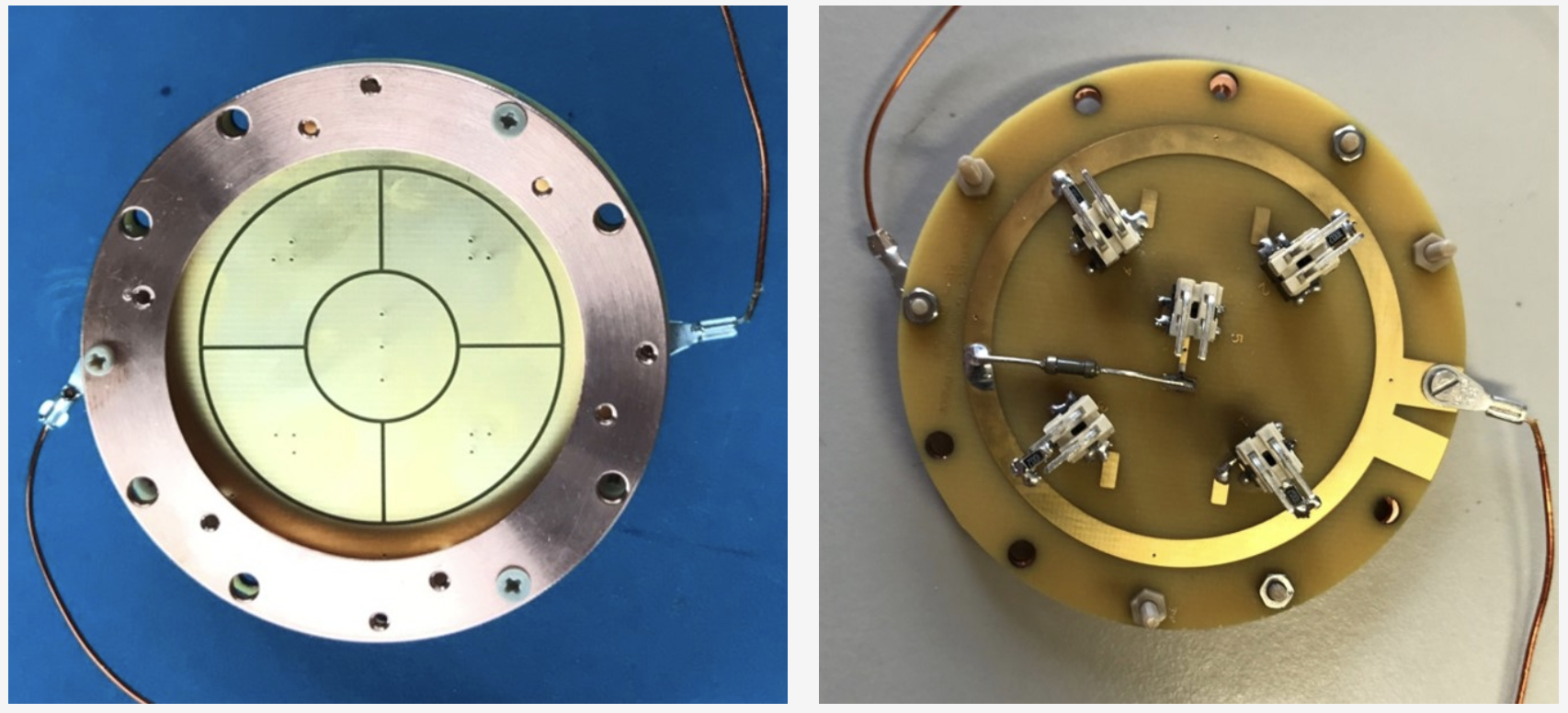
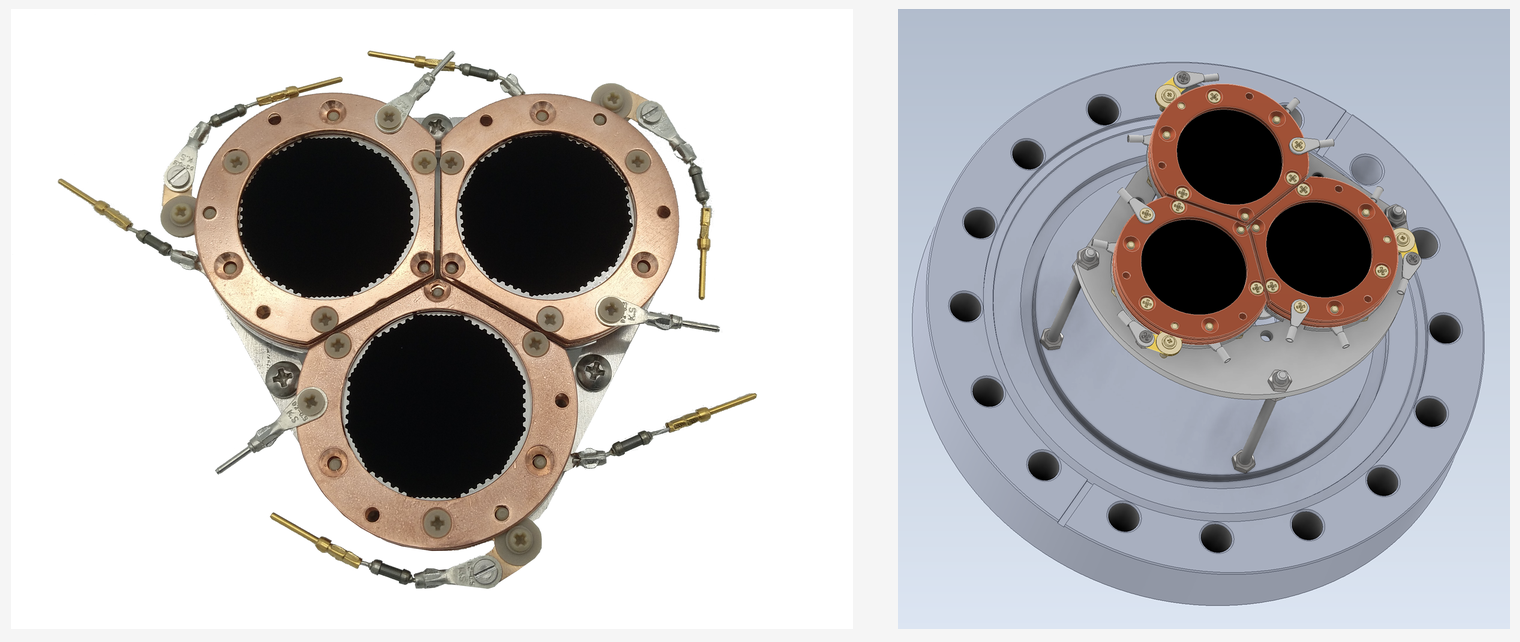
Depending on the number of readout elements RoentDek can provide adequate signal feedthrough and decoupling solutions based on the FT4/12/16TP product range, followed by standard timing electronics circuits or advanced readout via fast ADCs (fADC4) to allow for imaging applications with spatial resolution well below pixel size, employing charge-centroiding algorithms.
The DET40/75P with phosphor screen:
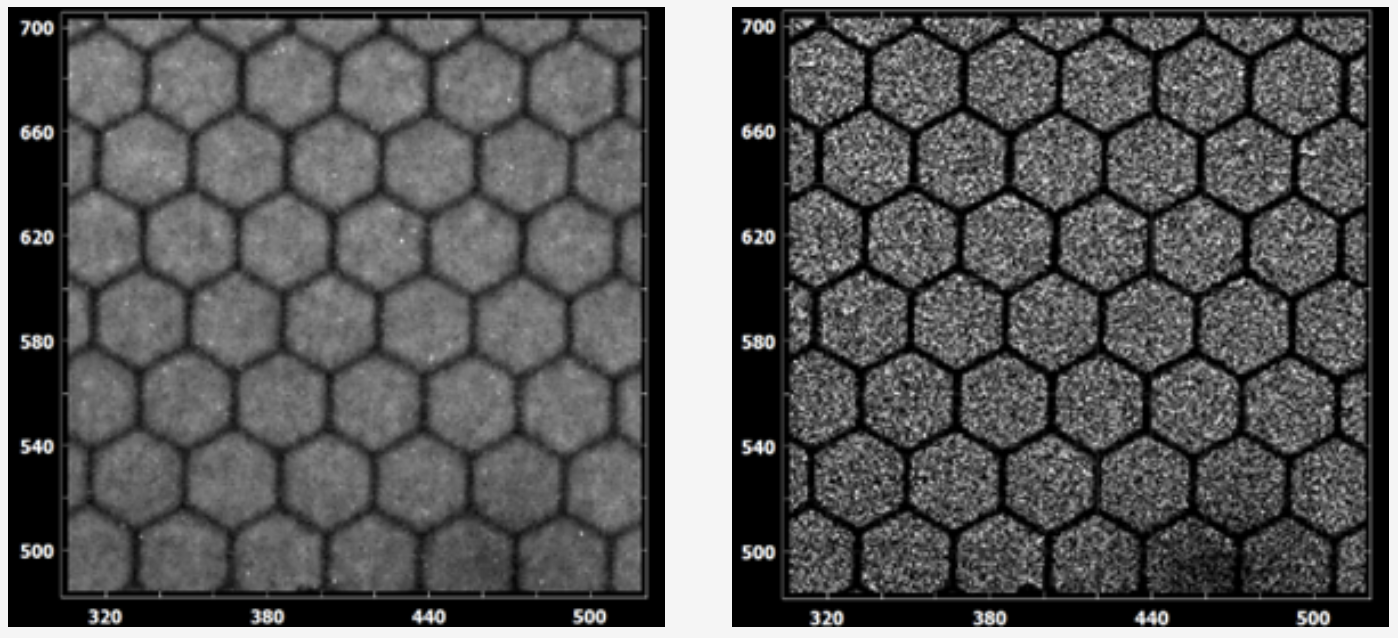
RoentDek offers the DET40/75 timing detector optionally with phosphor screen. Compared to “industrial-grade” assemblies, RoentDek supplies devices for high-end scientific applications. This means that the MCP stack is of same quality and specs as employed for single particle counting and imaging. The screen is of selected quality with choice of material. It does not need an aluminum cover so that decent light output is already achieved at comparably low bias. This makes handling, mounting and operation of the detector user-friendly (e.g. no excessive high voltage needed). The detector can be mounted anywhere inside the vacuum vessel as long as the screen can be viewed by a camera through a window. The assembly is modular, components can easily be replaced. It is possible to combine particle counting/timing with recording an image on the screen.
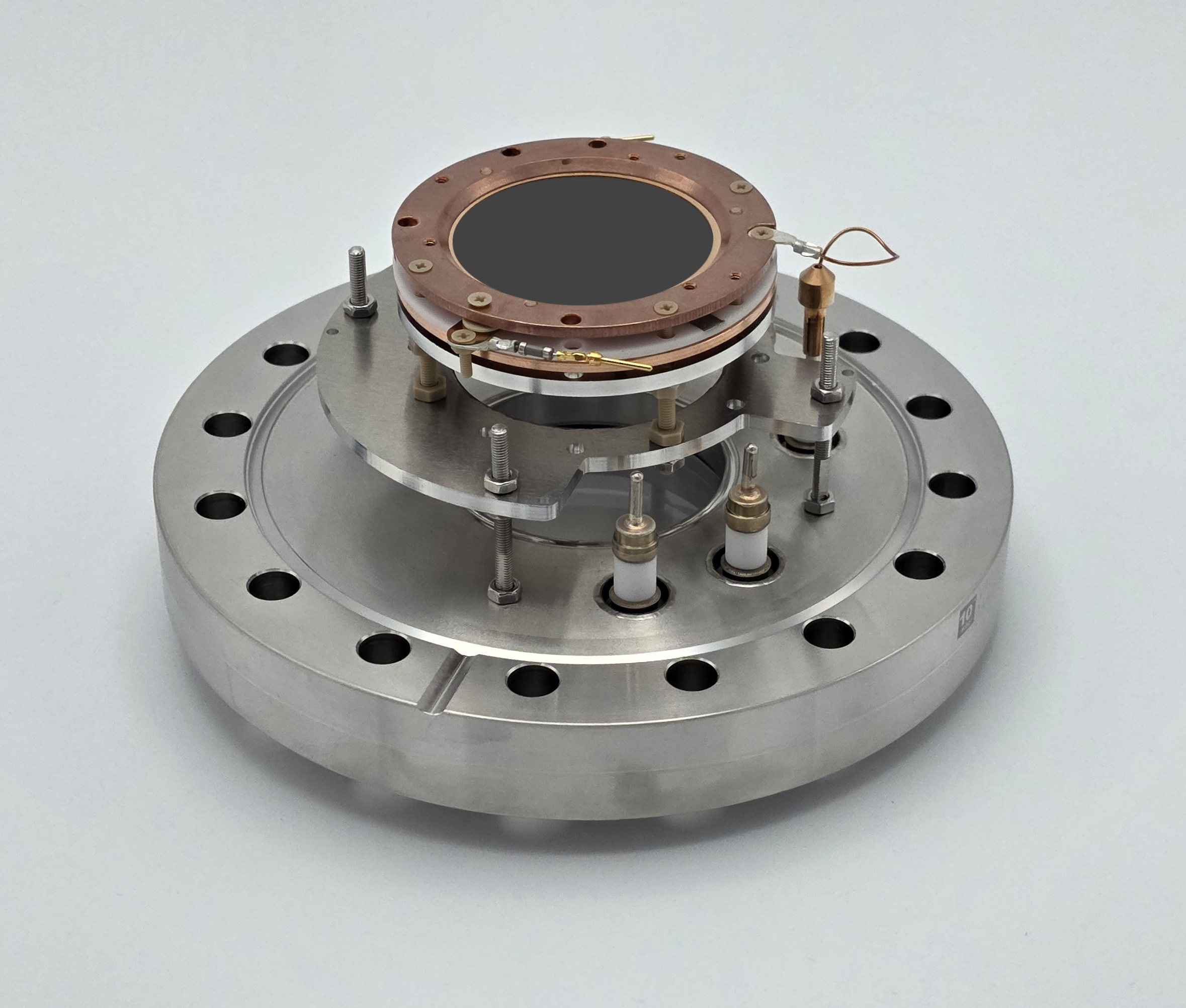
RoentDek also supplies detector mounting gear and flange with high voltage feedthroughs and embedded window or viewport.
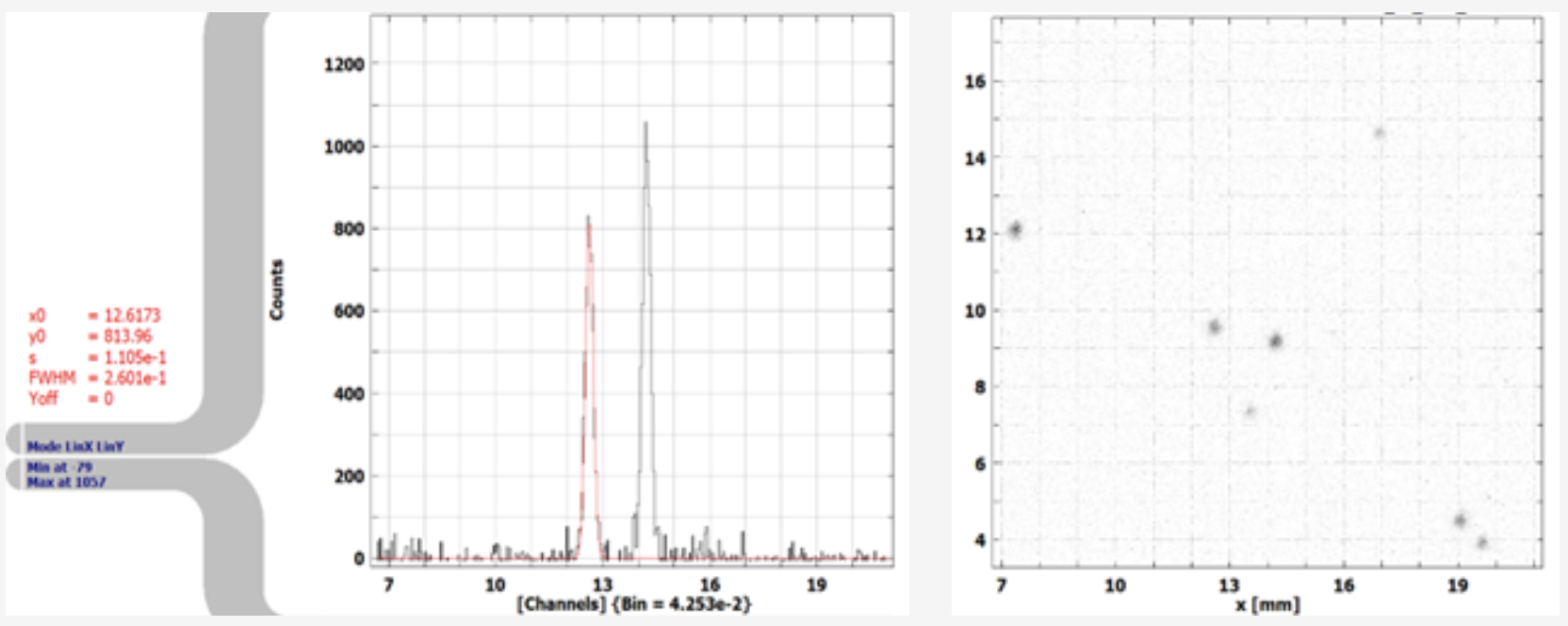
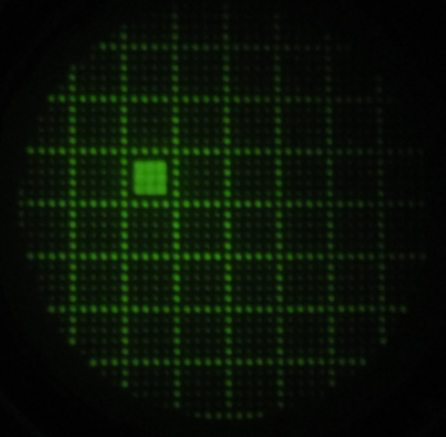
The RoentDek DET assemblies with phosphor screen anode can also be operated as timing detectors (pickup of time signal) and individual single particles in an image frame can be “counted” by an advanced “centroiding” image readout algorithm based on the CoboldPC software, as long as the particle rate is low enough for single particle MCP operation mode. The picture below shows the footprint traces of individual particles during a short camera exposure of the phosphor screen on a DET70P. Summing up all camera frames during a measurement period eventually produces an analog image. Spatial resolution is determined by the size of the footprints, here < 0.3 mm FWHM. By applying a “centroiding” algorithm, the spatial resolution can be significantly improved.