|
|

|
| |
THE RoentDek DELAY LINE DETECTOR WITH HEXANODE <<back to info page |
| |
|
| |
Unlike most other MCP detector system, the RoentDek delay-line detectors such as DLD40 and DLD80 have a high ability to detect multiple particle hits (multi-hits) and analyze the position and time coordinates ("3d-detection") for each individual particle (hit).
However, if the relative arrival time (timely pulse pair distance) between two individual hits is of the order of the electronic pulse duration in the front-end electronics or below, the information on these hits might be lost or become ambiguous. Furthermore, the pulse-pair resolution limit (pulse pair dead time) of the used multi-hit TDC can impose another limitation on the acceptable timely pulse pair distance, e.g. for the RoentDek detector system with multi-hit TDC the pulse pair dead time is 10-15ns.
If two hits are closer in time they can still be recovered if the relative distance in x and y position exceeds a certain value. For details please follow this link.
Of course these consideration are also valid for a particle shower with more than two hits. Then the smallest timely pulse pair distance between any two hits applies for the above considerations.
To improve the multi-hit ability in the region below 10ns timely pulse pair distance RoentDek has introduced a delay-line detector system with the novel Hexanode (patents pending). It is similar in many respects to the standard DLD detector systems, but the Hexanode has a third independent delay-line layer, i.e. three delay-line layers are mounted with a relative angle of 60°. Signals from any two of the layers are sufficient to give a performance according to the standard DLD detectors (with two perpendicular delay-line layers) as described above, but:
It can be shown that by having a redundant third delay-line layer a complete and unambiguous recovery of multi-hits (with two or more particles) can be done if the relative timely OR spatial relative distance between any two hits is above the pulse-pair dead-time Dpp or Dpp × v^, respectively (see this link).
|
|
| |
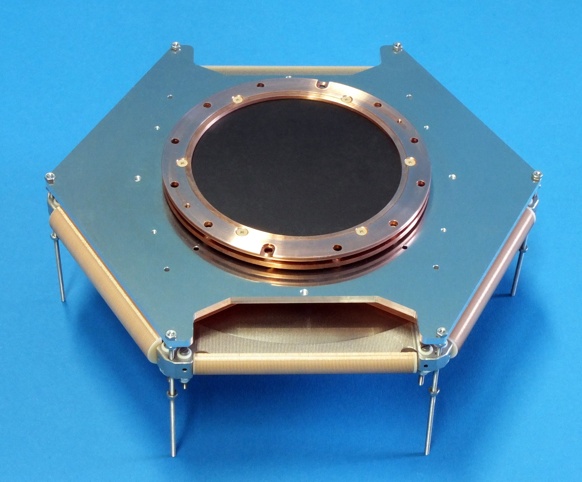 The HEX75
A delay-line anode with three layers for redundant multi-hit detection.
|
|
| |
In easier but less precise words: the hexagon delay-line anode is only blind for a hit pair if the particles come at the same time AND at the same position. |
|
|
| |
 |
|
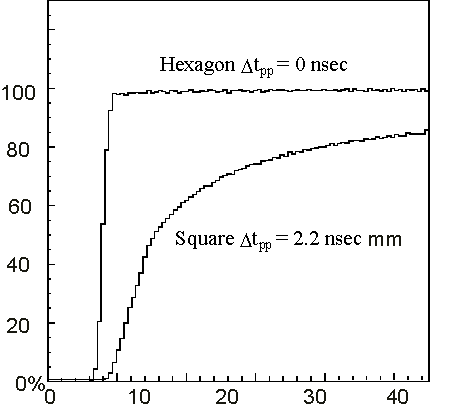
Recovery ratio as function of the spatial separation (in mm) of a pair of particles with identical TOFs, for DL80/Hexanode75 and 10ns
electronic dead-time.
Below:
Double-hit blind zones for DL80/Hexanode75 (in mm).
Plotted are relative distances between particle one and two.
|
|
|
| |
The following 2 images are not position images of the detectors. They show the RELATIVE POSITION between 2 particles
Relative distance between 2 particles at dT=2.5ns
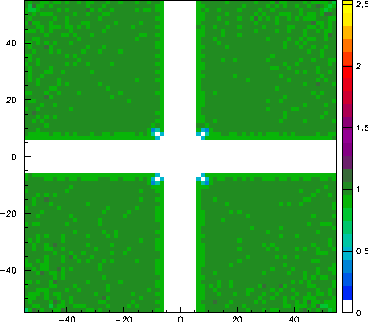
Square DL
electronic deadtime 10ns
&Delta tpp = 2.5ns
| |
Relative distance between 2 particles at dT = 0ns
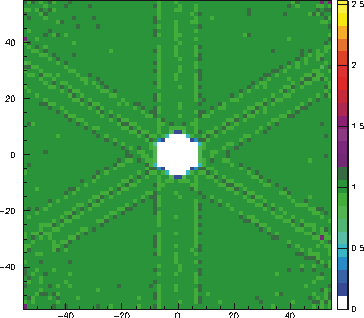
Hexagonal DL
electronic deadtime 10ns
&Delta tpp = 0ns
| |
| |
This situation of particle pairs arriving at the same time AND at the same position is very often excluded for physical processes as for example in case of a breakup of molecules (see next figure). For such processes the Hexanode removes any limitation of the delay-line method for multi-hit detection.
|
|
| |
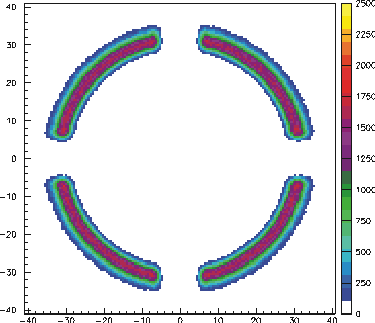
Square DL |
|
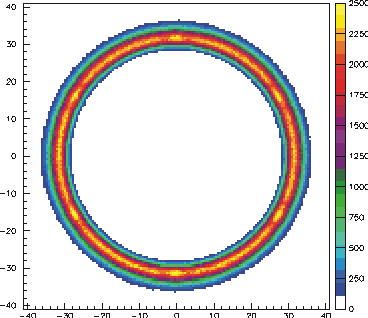
Hexagonal DL |
|
Simulation for Coulomb explosion of H2 in a COLTRIMS experiment
Only events are plotted for Dtpp < 4ns |
| |
DLD80 Anode
Δt < 100ns
Hex Anode
Δt < 5ns |
 |
DLD80 Anode
Δt < 100ns
Hex Anode
Δt < 5ns |
|
| |
Compare the DLD80 Anode with the Hex 80 Anode |
|
| |
RoentDek has introduced the HEX75, an 80 mm active delay-line detector as a standard product in 2001. Hexanodes for 50 mm and 100 mm detection diameter have also been produced recently.
|
|
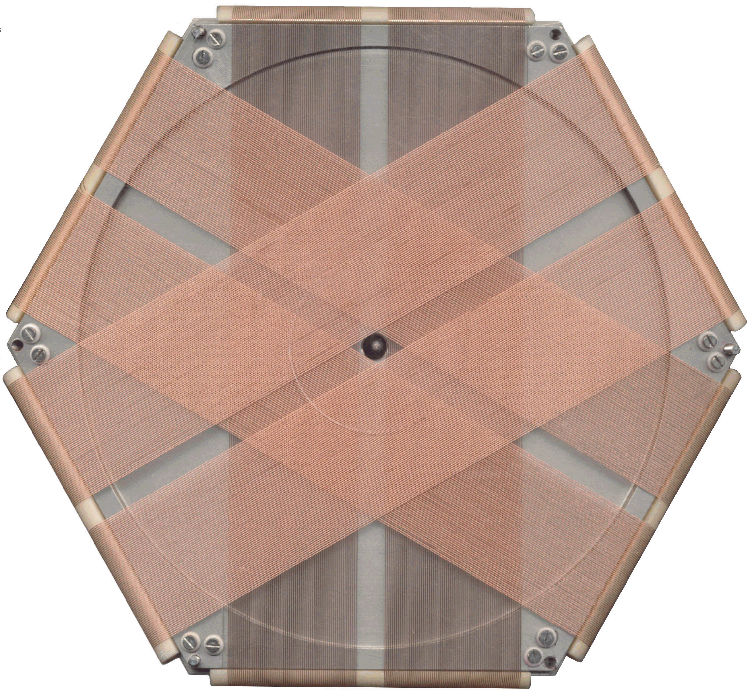
Hex80/o central hole diameter 6.4 mm |
| |
A triple-layer coverage also allows the construction of delay-line detectors with central hole. (These special detector designs with central hole do not provide multihit capability.)
The multi-hit ability of the Hexanode brings up the idea of using it for doubling count rate in experimental situations where only single hits are of interests but event rates are limited by the repetition rate of the ionizing source. An example is laser-driven ionization with fix rep rate but where the particle yield can be tuned (modifying intensity or target density) in the sense that more than one particle per shot is released towards the detector (see this link).
There are also other reasons for using a Hexanode in applications where multi-hit ability is not the main issue:
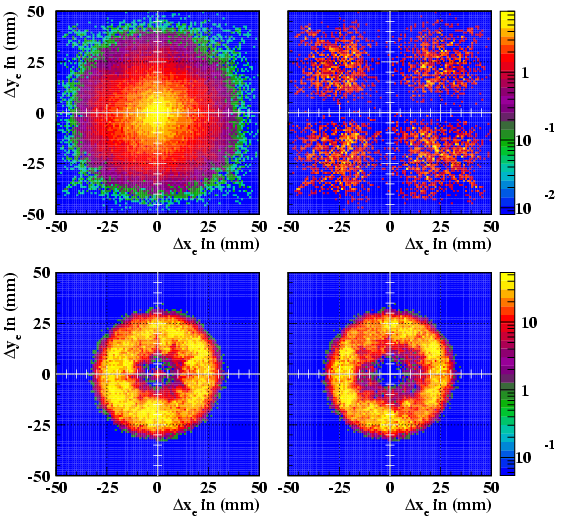
The same redundancy that allows for an advanced multi-hit recovery also enables determination and correction of image non-linearity, which is to some extent inherent to the individual delay-line arrays on any DLD. For the Hexanode an inherent calibration map can be produced which allows to improve global imaging linearity for single and multiple hit events.
Moreover, it is possible to determine spatial linearity and also the local resolution in an acquired image without need for using a test mask. (see figure below)
|
|
| |
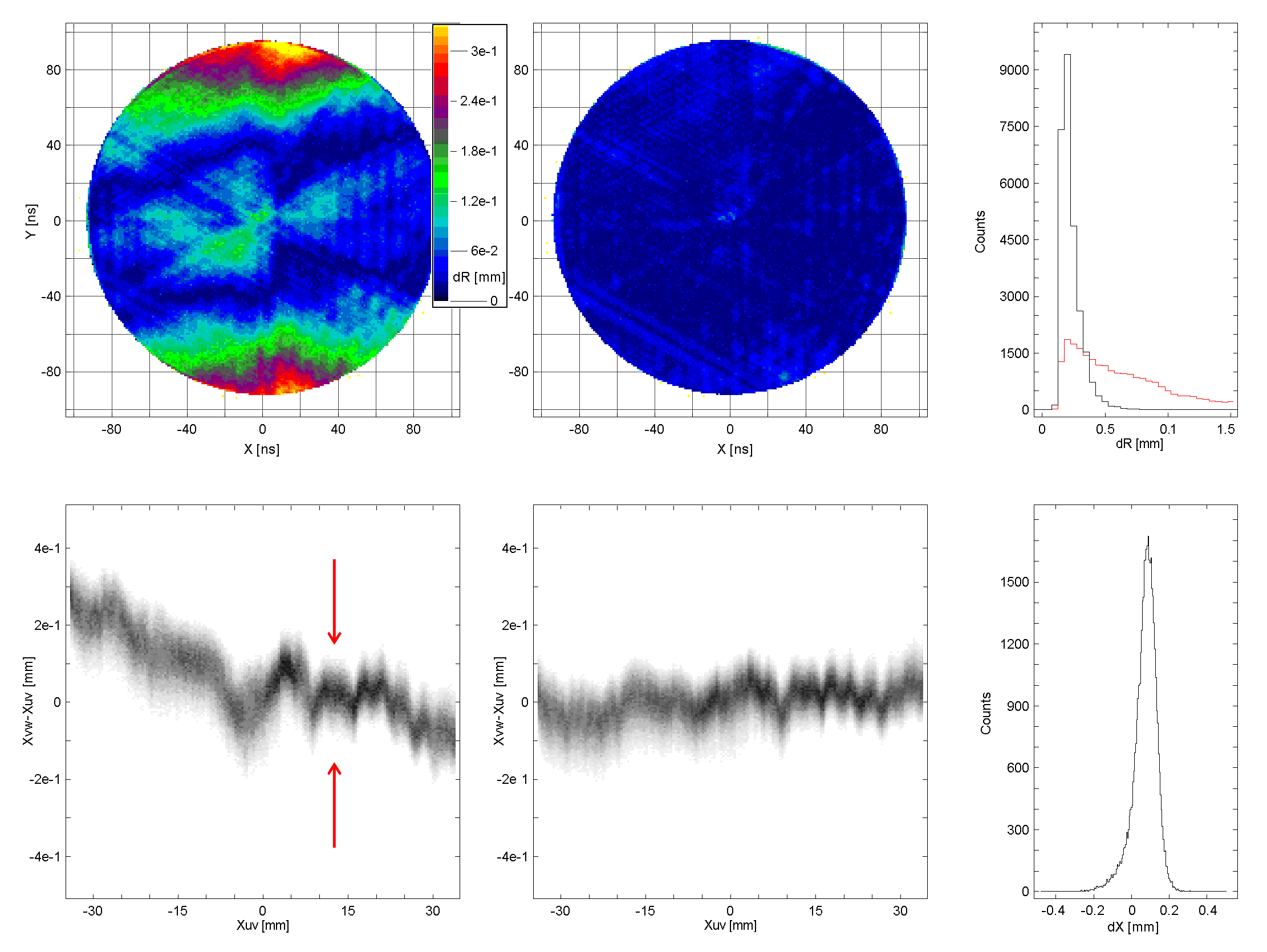
Figure: Plots illustrating the linearity and resolution control with a Hexanode. The amount of non-linearity in an image is mapped in the histogram up left where the deviations between measured positions using different layer combinations are displayed in the z-value (color-coded) for all X/Y positions on the detector (here: open face MCP detector with helical-wire Hexanode of 75mm active diameter). The deviations are due to linearity errors on the delay lines (lower left image: typical linearity deviation along a delay line). After correction for the deviation function the imaging properties can be significantly improved (middle images), down to the level of the local resolution error. The graphs up right show a 1d histograms of the abundances of certain position deviations in the image before (red) and after the correction, allowing a quantification of the detector linearity. Furthermore, the residuals in the linearity correction function allow the determination of local resolution (lower right image: projection at an arbitrary position indicated by red arrows). FWHM resolution of 110 micron in this plot corresponds to spatial detector resolution of about 60 micron FWHM. |
|
| |
For more information please inquire at:
 |
| |
|